



The 8:30pm Specification Test
Architects and designers aren’t only specifying products between 9 and 5.
The 8:30pm Specification Test asks a simple question: can they find the information and digital resources they need to confidently progress your product without having to speak to someone first?
Part 1 of Open for Business — A three-part series exploring how changing working practices and digital expectations are reshaping access to manufacturer product information.
Open for Business looks at a simple question for building product manufacturers: how easy is it for architects and designers to find, access and use the information they need to work with your products?
Across this three-part series, we explore how changing working practices and digital expectations are reshaping specification — from being available when designers want to work, to concerns about product IP, to understanding who is engaging with BIM content without creating unnecessary barriers to its use.
Is your digital presence keeping up with the way designers work?
Seeing the amount of activity on BIMcontent.com at night and on weekends got me thinking.
Architects and designers aren’t only searching for products and downloading BIM content between 9am and 5pm, Monday to Friday.
They’re doing it at night. They’re doing it on weekends. They’re doing it from home.
That shouldn’t really be surprising. The way people work has changed enormously.
But it raises an important question for building product manufacturers:
If an architect decided they wanted to specify your product at 8:30pm tonight, could they get everything they needed to confidently progress the specification without speaking to anyone at your company?
The answer says a lot about whether your specification strategy has kept pace with the way your customers now work.
The working day isn’t what it used to be
For decades, specification sales was built around a fairly predictable environment.
Architects and designers were generally in the office during conventional business hours. Specification representatives visited practices, ran lunch-and-learns, dropped off samples, brought in coffee or morning tea, presented new products and built relationships face-to-face.
Those activities still have value.
But they were developed for a different working environment and can no longer carry an entire specification strategy.
Hybrid and flexible working are now firmly established.
In Australia, 36% of employed people usually worked from home in August 2025. Among managers and professionals, the figure was 59%. Of those who usually worked from home, 23% said their main reason was greater flexibility or choosing their own hours, while 21% said it allowed them to catch up on work after hours. Australian Bureau of Statistics
Research specifically within Australian architecture paints a similar picture. The Association of Consulting Architects’ 2026 Pulse Check found remote work was available to at least some employees at 92% of responding practices, while flexible hours were available to all staff at 74%. Regular overtime was reported by 31% of practices, and 21% reported weekend work occurring regularly. Association of Consulting Architects
New Zealand is similar, with Stats NZ reporting that around a third of employed New Zealanders worked from home for at least some of their working week in its September 2024 data. Stats NZ
The point isn’t that everyone now works from home.
It’s that manufacturers can no longer assume their customers are all sitting in an office, working conventional hours, at the same time their sales and specification teams are available.

“Don’t call us, we’ll call you”
There’s another shift happening at the same time.
People have become accustomed to doing things themselves online. We research, compare, select, book and buy without necessarily wanting to speak to someone first.
Designers are no different.
An architect researching products may want to understand the range, compare alternatives, check technical information, download documentation and continue working on their project – without making a phone call, sending an email or arranging a meeting.
That doesn’t mean they never want to speak with a manufacturer.
They just might not want to speak with you yet.
The human interaction is increasingly happening when the designer decides they need it.
Being responsive isn’t the same as being available
You might have an excellent specification team that responds to every enquiry quickly.
That’s important.
But imagine an architect working on a project at 8:30pm.
They need to confirm whether your product is suitable for an application, check some technical information and download a Revit family so they can incorporate it into their model.
Your website tells them to “contact your local representative”.
Your representatives might be fantastic – responsive, knowledgeable and genuinely helpful.
But they’re not available at that moment, and the architect wants to keep working.
If another manufacturer makes the information and resources they need immediately available, you’ve introduced friction into the process that didn’t need to exist.
And this isn’t only an after-hours issue.
The architect could be working from home, on site or in another time zone. Or they could simply be sitting in their office at 2pm and prefer to find an answer in two minutes rather than email someone and wait for a response.
A digital presence should help designers make decisions
This is where having a strong digital presence becomes much more than having a good-looking website.
Think about what someone actually needs to do to select and specify your particular type of product. Ask the following:
- Can they understand your range and identify which products might suit their application?
- Can they compare alternatives based on the criteria that matter to their project?
- Can they easily access technical data, performance information, certification, specifications, finishes and installation information?
Depending on the product category, could a product selector, comparison matrix, calculator, configurator, optioneering tool or visualiser help them make a better decision?
And once they’ve made that decision, can they get the digital assets they need to incorporate the product into their project?
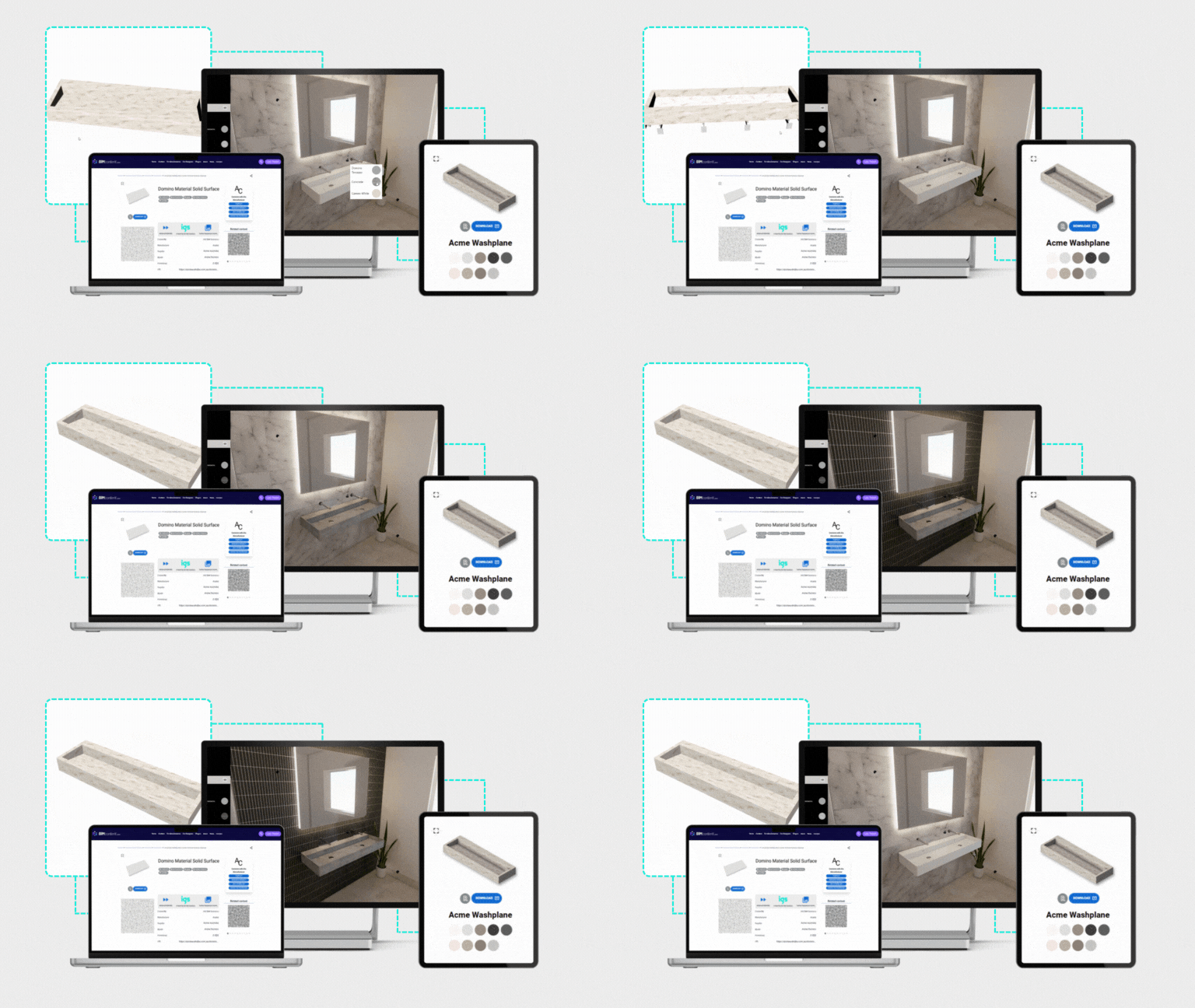
For many building products, that includes good-quality BIM and CAD content.
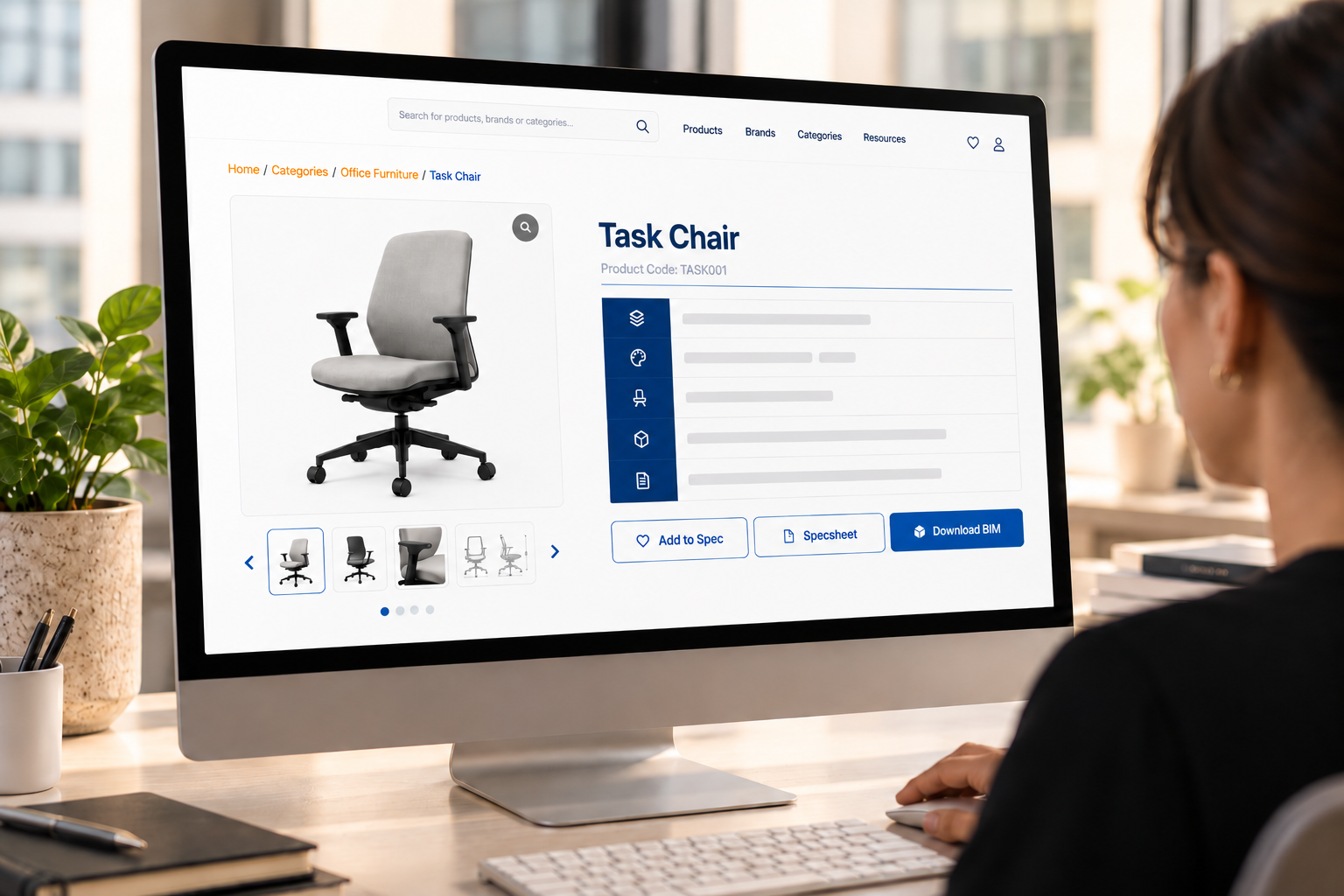
This is also where platforms such as BIMcontent.com form part of the broader digital ecosystem. Making BIM content available through the manufacturer’s own website is useful, but making it accessible through the platforms and tools designers already use – including directly within Revit – can remove another layer of friction.
There’s also a broader reason this matters: BIM content can influence product consideration earlier in the design process than many manufacturers realise. Why BIM Content Drives Specification Earlier Than You Think
Not every manufacturer needs every digital tool.
The more useful question is:
What does a designer need to do to confidently select and specify our products – and how much of that process can we make easier for them digitally?
This isn’t about replacing the spec rep
Quite the opposite.
Good digital tools can make good specification people considerably more effective.
Imagine a designer needs help determining which product is appropriate for a particular project.
Without effective digital resources, a specification rep might need to explain the range, identify suitable products, send technical PDFs, provide drawings, answer questions about different options and then send BIM or CAD files.
There could easily be multiple interactions before the designer gets what they need.
Now consider the same situation when the designer has already researched the range, used a selection tool to narrow their options, reviewed the technical information and downloaded the BIM content themselves.
When they eventually contact the specification rep, the conversation might start somewhere very different:
“I’ve narrowed it down to these two options. Given the requirements of this project, which would you recommend?”
That’s a much better use of the rep’s expertise.
Digital self-service doesn’t remove the human element. It removes unnecessary human effort.
Instead of spending time finding PDFs, sending files and answering questions that could have been answered instantly online, specification teams can spend more time understanding projects, solving problems, providing technical advice and building relationships.
And that potentially allows the same team to meaningfully support far more designers and projects.
The specification strategy needs to change with the working environment
Lunch-and-learns aren’t dead. Neither are practice visits, samples, presentations, phone calls or relationships.
They’re still valuable.
But they can’t be the entire strategy when the people you’re trying to influence aren’t necessarily working in the same place, at the same time, or in the same way they once did.
The strongest approach is increasingly a combination of the two.
Great people, supported by a great digital experience.
Your website, product information, selection tools, technical resources, BIM libraries and other digital assets allow designers to keep moving when they want to work independently.
Your people are then available when their expertise, advice and relationships genuinely add value.
And that brings us back to the 8:30pm test.
- Go to your own website and pretend you’re an architect who has never dealt with your company before.
- Choose one of your products and try to specify it.
- Don’t use any internal knowledge. Don’t access anything your customers can’t access. And don’t call or email anyone for help.
How far can you get?
The answer might tell you more about your specification strategy than you expect.
And if your immediate reaction is, “But what about protecting our IP?” or “Don’t we want their contact details before we give them all of this information?” – those are fair questions. They’re also a discussion for another article.
Continue the Open for Business series
This article is Part 1 of Open for Business, a three-part series exploring how changing working practices and digital expectations are reshaping access to manufacturer product information.
Part 2: Does BIM Content Really Put Your Product IP at Risk?
Does making BIM content easily accessible expose valuable product IP — or does restricting access create a bigger commercial risk?
Part 3: What Should You Know About Who Is Using Your BIM Content?
How can manufacturers understand who is using their BIM content and the value of that engagement without creating unnecessary barriers?
References
Australian Bureau of Statistics – Working arrangements, August 2025
Association of Consulting Architects Australia – ACA Pulse Check 2026: National key findings
... Return to the Knowledge Hub ...
Table of Contents
Sign up today for news, industry insights & content releases!
You can unsubscribe at any time by clicking the link in the footer of our emails. For information about our privacy practices, please visit our privacy policy.
FAQs
Related Posts



The building industry is rapidly evolving. Don’t get left behind!
Join the growing list of leading brands who leverage our BIM Content Creation Services
and associated Building Product Marketing Strategies to grow your business.
Contact Us
We look forward to speaking with you!
For inquiries about BIM content creation, web or product marketing solutions as well as general inquiries and support, please fill out the contact form provided, or contact us via the details below.
1300 980 763