



Why We Don’t Always Do What the Client Says
The manufacturer should define the product and what their BIM investment needs to achieve. But that doesn’t necessarily mean they should define the technical solution. We explore why good manufacturer BIM content requires a balance of product knowledge, specialist BIM expertise and an understanding of how designers will actually use the content in real projects.

This post was written by:

-
Owner & Managing Director, IGS GroupThis post was written and submitted by an individual contributor and does not reflect the views or attitudes of IGS Group or BIMcontent.com as a whole. About the author:
Why We Don’t Always Do What the Client Says
When it comes to BIM content, the manufacturer should define the product and the outcome. But that doesn’t necessarily mean they should define the technical solution.
“The client is always right.”
I understand the sentiment behind it. But after more than 15 years working with Building Product Manufacturers on BIM content, I don’t think it’s always true.
If a client asks us to do something that we know will make their BIM content worse, I don’t think good customer service is simply doing it.
Our job is to understand what they’re trying to achieve, explain the implications of what they’re asking for and, where necessary, recommend a different approach.
That happens more often than you might think.

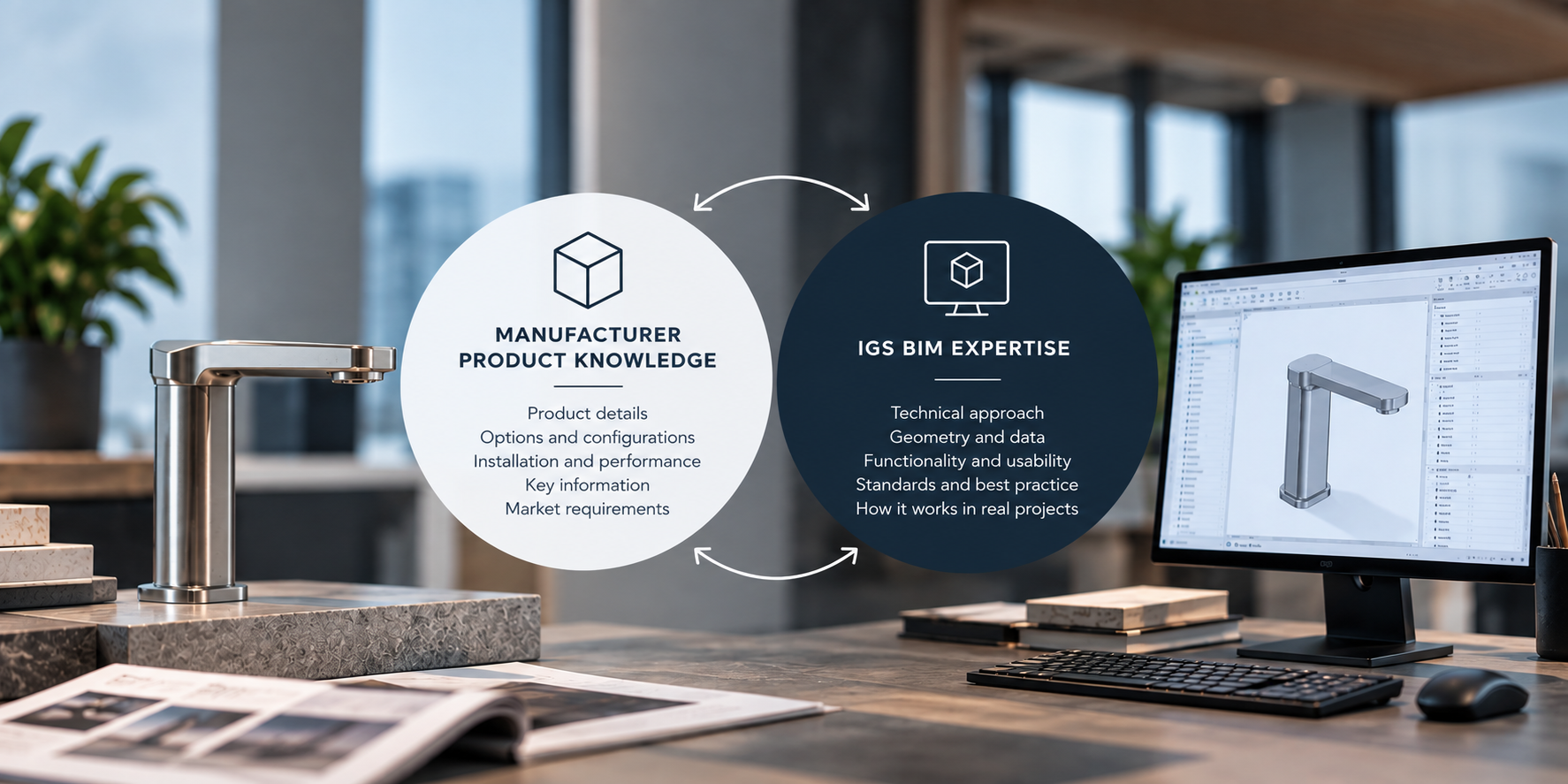
Manufacturers know their products. We know how they need to work in BIM.
One of the first things we establish on a BIM content project is that there are two quite different areas of expertise involved.
The manufacturer knows their product better than we ever will. They know how it works, how it’s configured, what options are available, how it’s installed, what information is important and how they want it represented in the market.
We need that knowledge.
But most manufacturers don’t spend their days working inside Revit projects. They don’t necessarily know how an architect will use their Revit family, how it will interact with the rest of a project model, which parameters are genuinely useful, how much geometry is appropriate, or whether a piece of functionality that sounds useful on paper will actually improve the experience for the designer.
Nor should we expect them to know those things.
That’s part of the reason they’ve engaged us.
Having now worked on more than 500 BIM content projects for over 160 manufacturer brands, we’ve encountered a lot of different products, briefs and opinions about how BIM content should be created.
A big part of our BIM content creation process is working out where the manufacturer’s product knowledge ends and where our BIM expertise needs to take over.
In simple terms, I think about it like this:
The manufacturer tells us what the product is and what they want the BIM content to achieve. Our job is to work out the best way for the content to achieve it.
More isn’t always better
This is probably one of the most common conversations we have.
A manufacturer gives us a highly detailed 3D model of a product and understandably assumes the best result would be to retain as much of that detail as possible in Revit.
From their perspective, why would you deliberately make the product less accurate?
The problem is that geometric accuracy and BIM usability aren’t quite the same thing.
A designer isn’t viewing that product in isolation. It could end up in a Revit project containing hundreds or thousands of other objects. They generally don’t need every screw, fixing, internal component or small piece of geometry simply because it exists in the manufacturer’s source model.
There are plenty of situations where detail is useful, of course. The skill is knowing what matters for that particular product and how it’s going to be used.
The same applies to data.
We’ve seen BIM briefs containing enormous lists of parameters because someone has taken the view that if the information exists somewhere in the business, it should probably be included in the BIM object.
Again, I understand the thinking.
But a Revit family doesn’t need to become a database containing every piece of information the manufacturer has about the product. The important question is what information will actually help someone select, specify, configure or document that product.
Functionality is another good example. It’s quite easy to keep adding features to a Revit family because each one sounds useful in isolation. Eventually, though, you can end up making something more complicated to use rather than better.
Good BIM content is usually about finding the right balance.
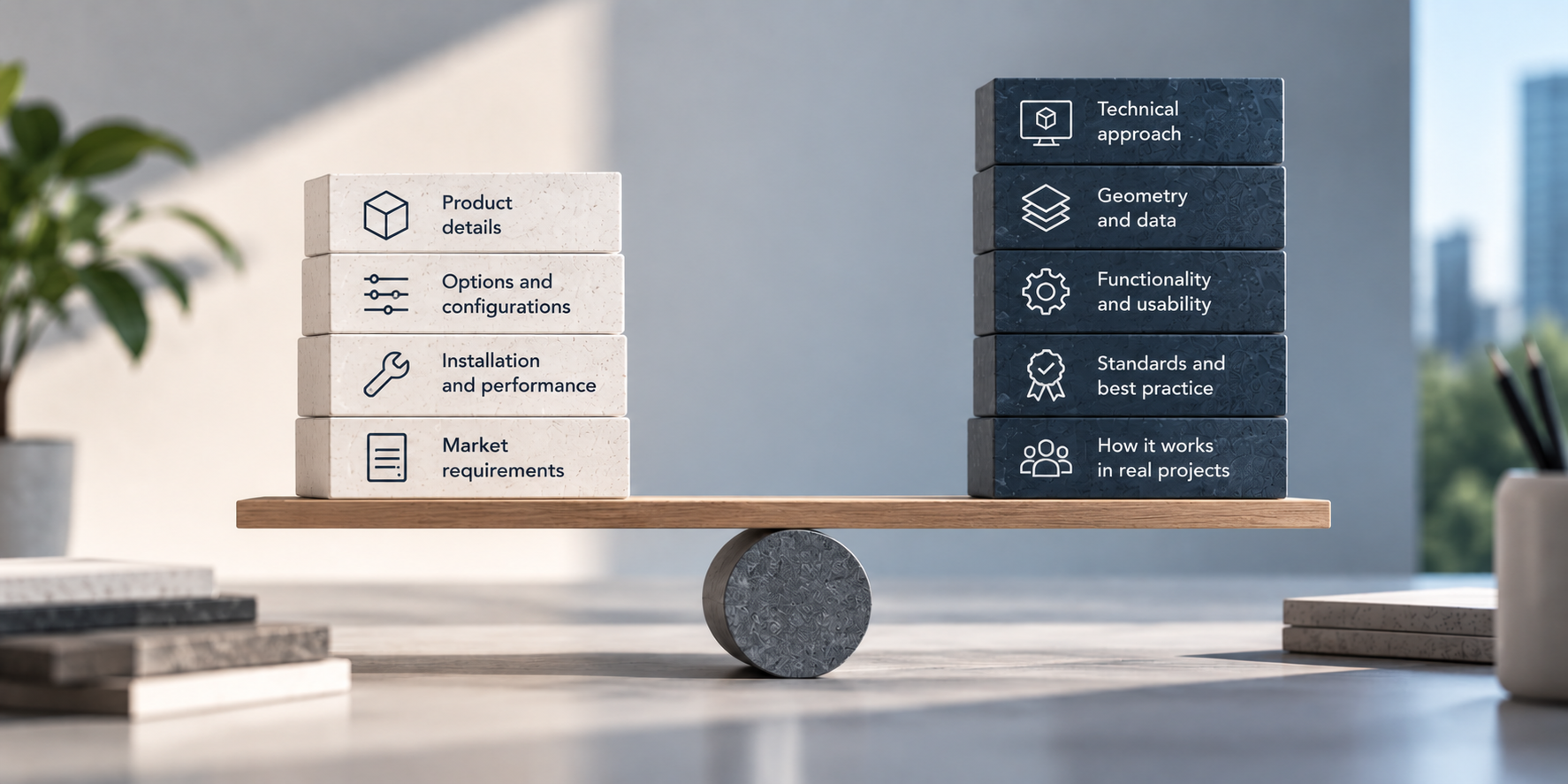
So what actually makes good manufacturer BIM content?
For us, good manufacturer BIM content needs to accurately represent the product while still being efficient, intuitive and practical to use in a real project.
It should give designers the geometry, information and functionality they genuinely need without adding complexity for the sake of it.
Exactly what that means varies enormously by product category.
A door, a tap, a roofing system and a piece of furniture don’t need the same information or behave in the same way. That’s one of the reasons I’m wary of overly rigid BIM content rules that try to apply the same approach to every manufacturer and every product.
There are certainly principles and standards we follow, but good BIM content also requires judgement.
And that’s where experience matters.
Sometimes we have to push back
There have been plenty of occasions where a client has asked us to do something and our response has effectively been:
We can do that. But we don’t think we should.
That’s not us being difficult. If anything, just saying yes would usually be easier.
Instead, we’ll explain what we think the issue is, why it matters and what we’d recommend doing instead.
Sometimes the client agrees immediately. Sometimes it takes a few conversations. And occasionally we’ll test different approaches before we settle on the answer.
The important thing is that we’re not pushing back because we have a preferred way of doing things and refuse to deviate from it. We’re pushing back because we think there’s a better outcome for the manufacturer and, importantly, for the people who are ultimately going to use the content.
There’s another client in the room
I often think there are actually three parties involved in one of our BIM content projects.
There’s the manufacturer, there’s us, and then there’s the architect, engineer, BIM manager or other design professional who will eventually use what we’ve created.
That third person isn’t normally sitting in our project meetings, but we need to represent their interests throughout the process.
Because ultimately, they’re the one who decides whether the content is any good.
If a manufacturer loves its new BIM library but designers find it frustrating to use, we’ve missed the point.
This is one of the reasons we’ve spent so much time over the years talking directly to designers and BIM managers about manufacturer content. We also established our BIM Advisory Group, which brings together BIM and Design Technology specialists from leading Australian and New Zealand design practices. Their input helps us understand what design practices actually expect from manufacturer BIM content, where common problems occur and how those expectations are changing.
We combine that industry input with what we’ve learned from hundreds of manufacturer BIM projects to inform our content creation methodologies and the quality standards we apply to content available through BIMcontent.com.
So when we recommend simplifying geometry, changing how information is structured or taking a different technical approach, that recommendation isn’t based purely on our own view of how BIM content should be created. It’s informed by years of experience creating the content and ongoing input from the people who ultimately have to use it.
“It’s what the client asked for”
Every now and then we’ll review BIM content created elsewhere and find something that clearly isn’t working particularly well.
It might be unnecessarily heavy geometry, a confusing collection of parameters, an awkward family structure or functionality that makes the object harder to use than it needs to be.
And occasionally the explanation is:
“That’s what the client asked for.”
I’ve never been particularly comfortable with that answer.
A specialist has to take some responsibility for the advice they provide.
If a manufacturer asks for something that we think is going to negatively affect the usability or performance of its BIM content, I think it’s our responsibility to say so.
That doesn’t mean the client has no say. Far from it. It’s their product, their brand and their investment.
But they’re also paying us for expertise.
If all we did was take instructions and build exactly what was written in a brief, we’d be providing a very different service.
BIM content isn’t really about Revit files
This is probably the most important part of the whole discussion.
Most manufacturers don’t actually want BIM content.
They want what BIM content can help them achieve.
They want to make it easier for architects and other designers to work with their products. They want their products considered earlier in the design process. They want to improve the experience of specifying their products and, ultimately, they want to win more specifications and projects.
The Revit files are a means to that end.
That’s why we’ve always viewed manufacturer BIM libraries as commercial assets rather than simply technical deliverables.
If we create a technically impressive Revit family that designers don’t want to use, I don’t think we’ve done our job particularly well.
On the other hand, if we can make a manufacturer’s product easier to select, configure, specify and document, then BIM starts doing what the manufacturer invested in it to do.
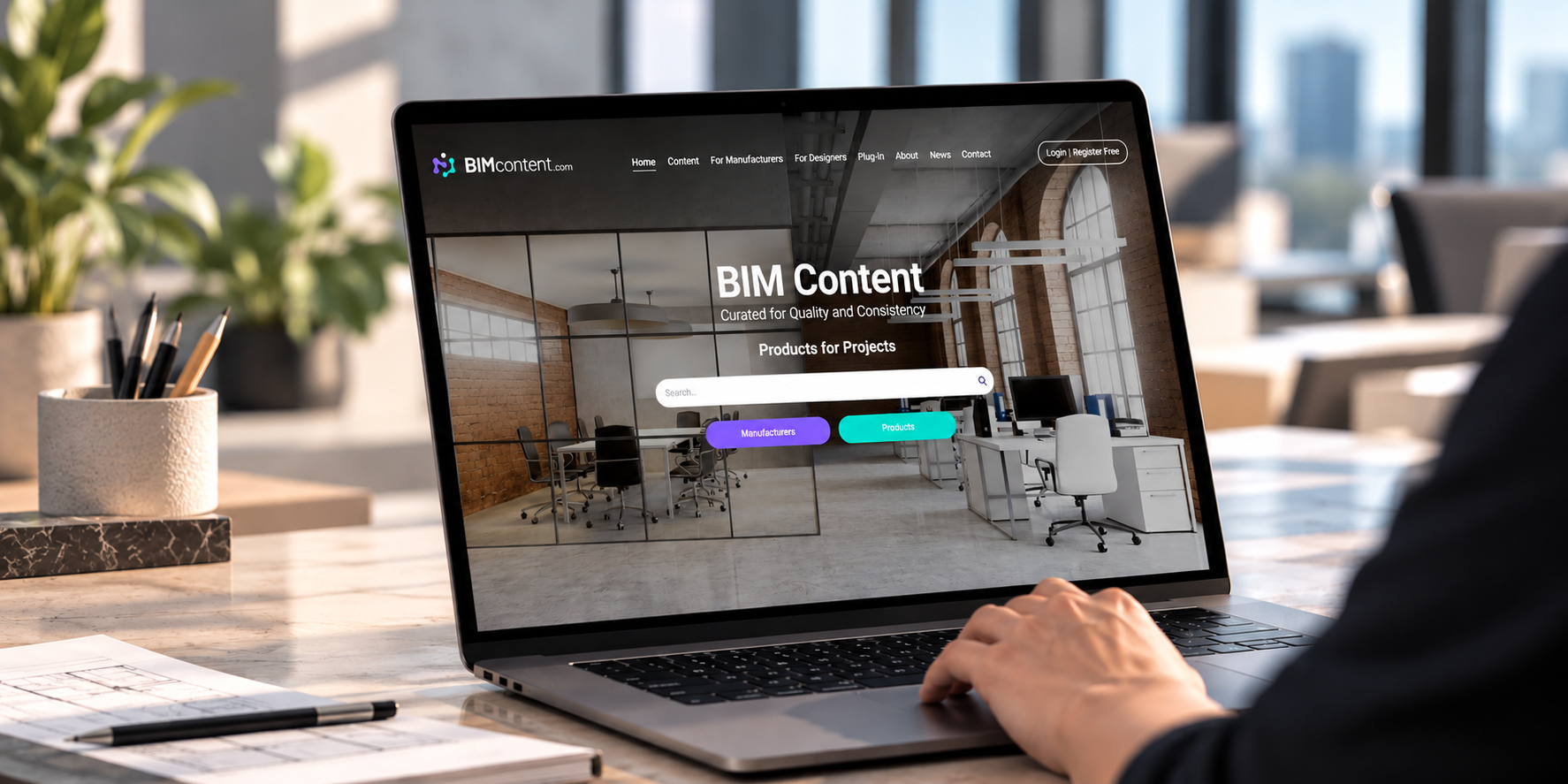
It’s also why we developed BIMcontent.com. Creating good BIM content is one part of the equation. Making it easy for the design community to find, access and use that content is another.
So, is the client always right?
When it comes to their product, absolutely.
When it comes to what they want their investment to achieve, we need to listen very carefully.
But when it comes to exactly how their BIM content should be built, that’s where I think a good specialist needs to be prepared to have an opinion.
Sometimes that means recommending a different approach. Sometimes it means explaining why adding more detail, data or functionality isn’t going to make the content better. And sometimes it means saying no.
Not because we aren’t listening to the client.
Because we are.
And because after more than 15 years doing this, part of the value we should be bringing to the table is knowing when there’s a better way.
Written by:
-
Owner & Managing Director, IGS GroupThis post was written and submitted by an individual contributor and does not reflect the views or attitudes of IGS Group or BIMcontent.com as a whole. About the author:
Luke Johnston is the Owner and Managing Director of IGS Group and BIMcontent.com, with over 20 years’ experience in building product sales and marketing. Internationally recognised as an authority on BIM content development, Luke is known for his strategic insights, partnering with manufacturers and design firms to implement and enhance their BIM strategies. He has advised and delivered BIM solutions to over 150 manufacturers globally and is passionate about helping businesses leverage design technology as a powerful tool for specification growth and commercial success.
... Return to the Knowledge Hub ...
Table of Contents
Sign up today for news, industry insights & content releases!
You can unsubscribe at any time by clicking the link in the footer of our emails. For information about our privacy practices, please visit our privacy policy.
FAQs
Related Posts


The building industry is rapidly evolving. Don’t get left behind!
Join the growing list of leading brands who leverage our BIM Content Creation Services
and associated Building Product Marketing Strategies to grow your business.
Contact Us
We look forward to speaking with you!
For inquiries about BIM content creation, web or product marketing solutions as well as general inquiries and support, please fill out the contact form provided, or contact us via the details below.
1300 980 763