



The BIM Feedback Gap: Why Good Feedback Doesn’t Always Mean Good BIM Content
Positive feedback about your BIM content is encouraging—but it doesn't always tell the full story. Here's why manufacturers can receive glowing reviews while still missing specification opportunities within architectural practices.

Building product manufacturers often judge the quality of their BIM content by the feedback they receive from architects, designers and other customers.
Positive feedback is useful, but it rarely tells the whole story. Manufacturers generally have limited visibility of what happens after a BIM file is downloaded and introduced into a design practice.
A designer might use the content exactly as supplied. They might modify it before using it. A BIM Manager may decide it does not meet the practice’s standards. Someone may recreate the object internally, substitute another manufacturer’s content, or simply stop using it.
In many of those situations, nobody goes back to the manufacturer to explain what happened.
We call this the BIM Feedback Gap: the difference between the feedback manufacturers receive about their BIM content and what may actually be happening when that content is assessed and used inside design practices.
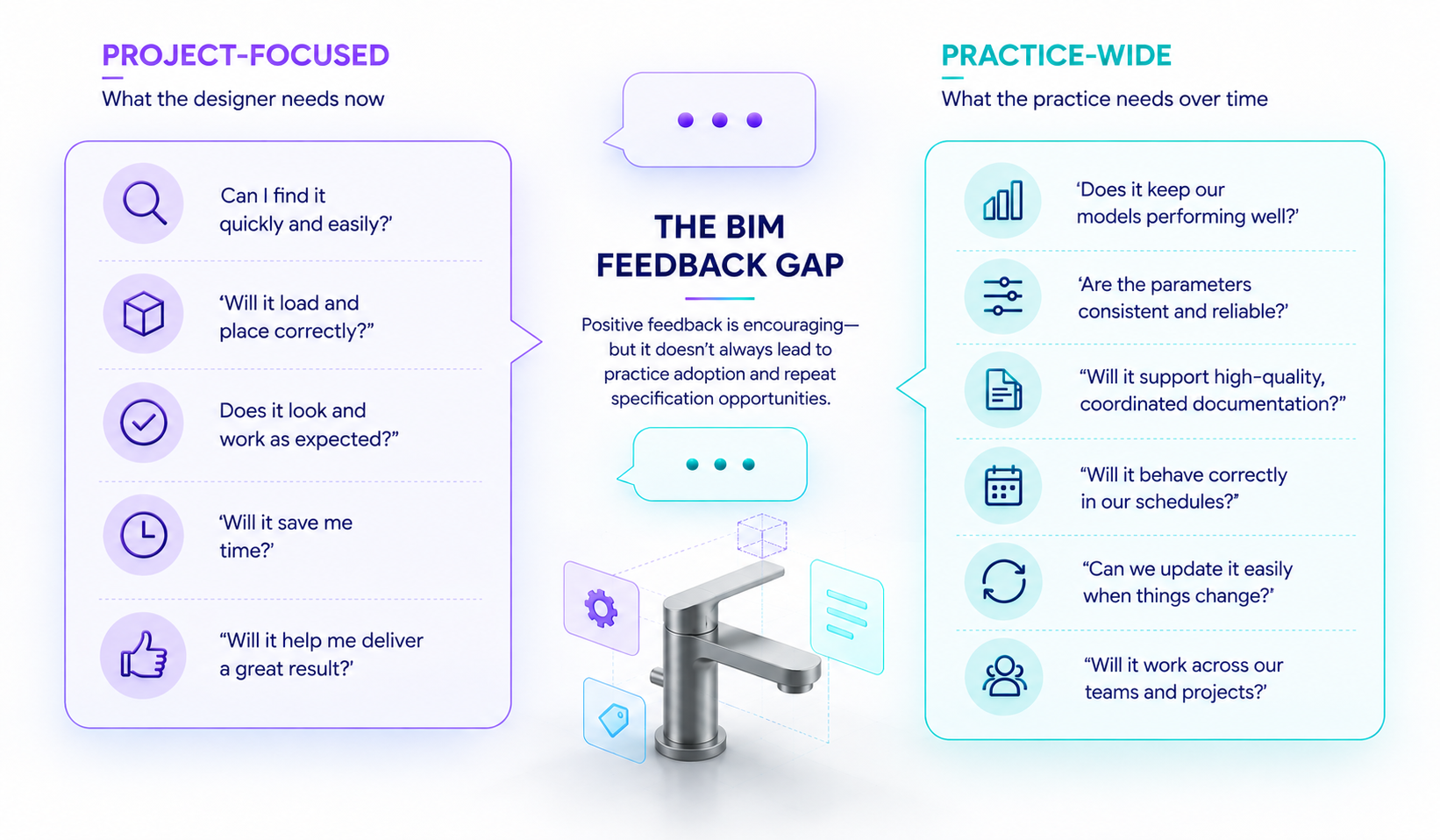
Why poor BIM content doesn’t always generate complaints
When a product is defective, customers usually have a reason to report the problem. BIM content can behave differently.
If a Revit family is difficult to use, too heavy, poorly structured or inconsistent with a practice’s standards, an experienced designer may be able to work around the problem. They might edit the family, strip information out, rebuild it or replace it with something else.
From the manufacturer’s perspective, that interaction can be almost invisible. The file was downloaded and there was no complaint. It is easy to interpret that as evidence that the content is working well.
For the designer, however, the content may have created additional work rather than saving it.
Silence is therefore not the same thing as approval. Some of the most important problems with manufacturer BIM content may never be reported to the manufacturer at all.
A Revit family can work and still be poor BIM content
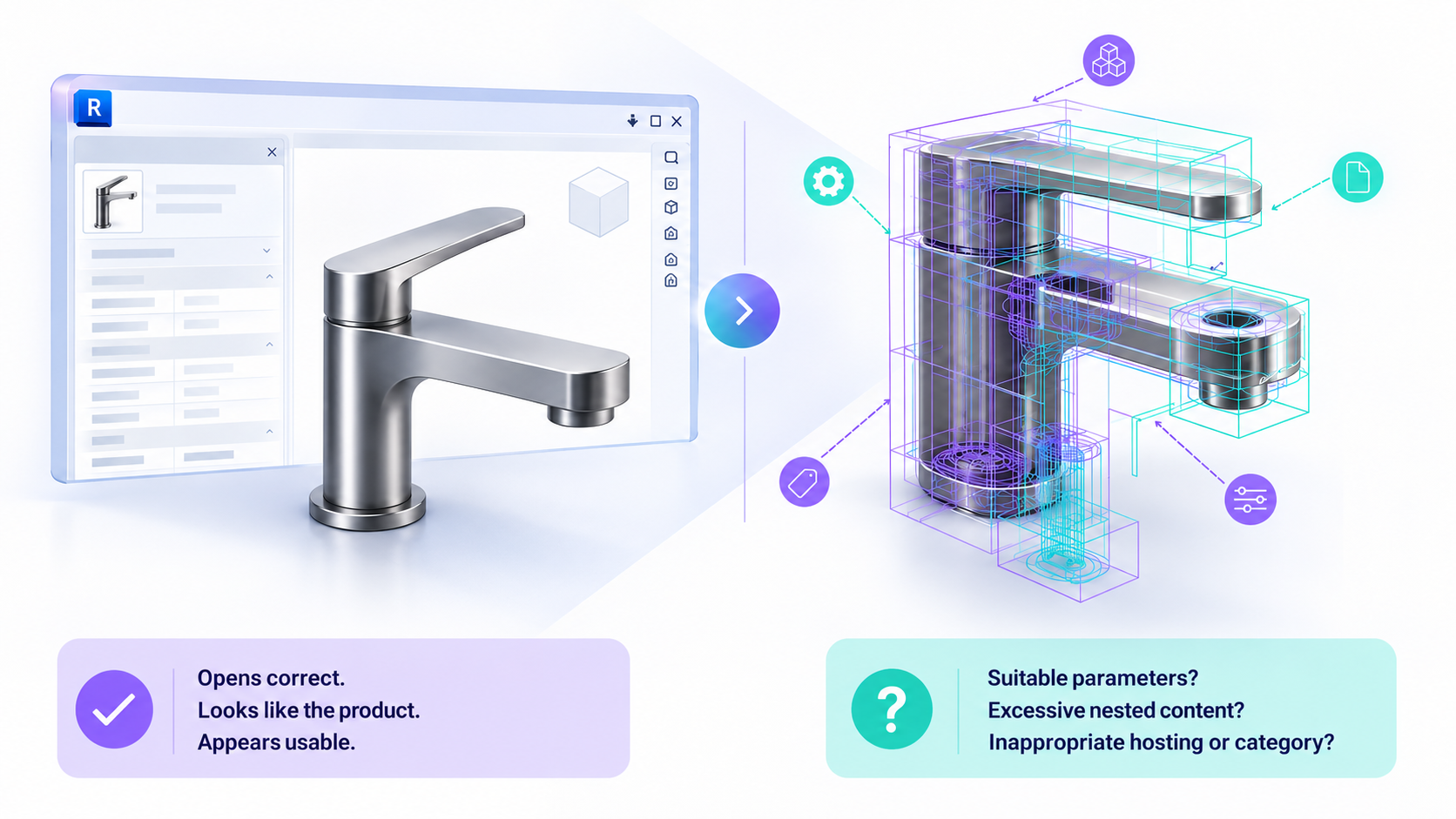
One of the challenges for manufacturers reviewing existing BIM content is that poor-quality content does not necessarily look broken.
A Revit family can open correctly, look like the manufacturer’s product and appear perfectly usable during a quick review. It may even have been used successfully on individual projects.
That does not necessarily tell you whether it has been developed appropriately for wider use in live project environments.
Issues such as unnecessary geometric complexity, oversized files, inappropriate hosting, poor category selection, inconsistent naming, unsuitable parameters, excessive nested content, materials, connectors or other technical decisions may only become apparent when the content is assessed by someone responsible for maintaining project and practice standards.
This is why a visual review alone is rarely enough to assess the quality of manufacturer Revit content.
Individual use and firm-wide BIM adoption are different things
A designer and a BIM Manager may look at the same manufacturer BIM object through different lenses.
An individual designer may primarily want to know whether the object represents the product they need, looks appropriate in the project and can be placed and configured without too much effort.
A BIM Manager or BIM Coordinator may need to consider a broader set of issues before allowing manufacturer content to become part of a firm’s project workflow or internal library. These can include model performance, file size, geometric complexity, parameters, categories, hosting methodology, materials, naming, maintainability, consistency and compatibility with the practice’s own standards.
The exact review process varies between practices, and not every firm manages third-party content in the same way. The important point for manufacturers is that positive feedback from an individual user does not necessarily tell you how the content would perform under a more detailed technical review.
What do BIM Managers look for in manufacturer BIM content?
There is no single checklist used by every design practice, but good manufacturer BIM content generally needs to balance several requirements at once.
- Accuracy – the geometry, dimensions, configurations and product information should correctly represent the real product.
- Usability – designers should be able to place, configure and work with the content efficiently.
- Model performance – the content should avoid unnecessary geometry, data and complexity that can burden project models.
- Consistency – naming, parameters, materials, behaviour and graphical representation should be predictable across the manufacturer’s library.
- Appropriate functionality – parameters, hosting, connectors and other behaviours should support the way the product is actually designed and documented.
- Maintainability – the content should be practical to manage as products, software versions and manufacturer information change over time.
The aim is not to make manufacturer BIM content technically complicated. It is to make it reliable, efficient and appropriate for the project environments in which designers will use it.
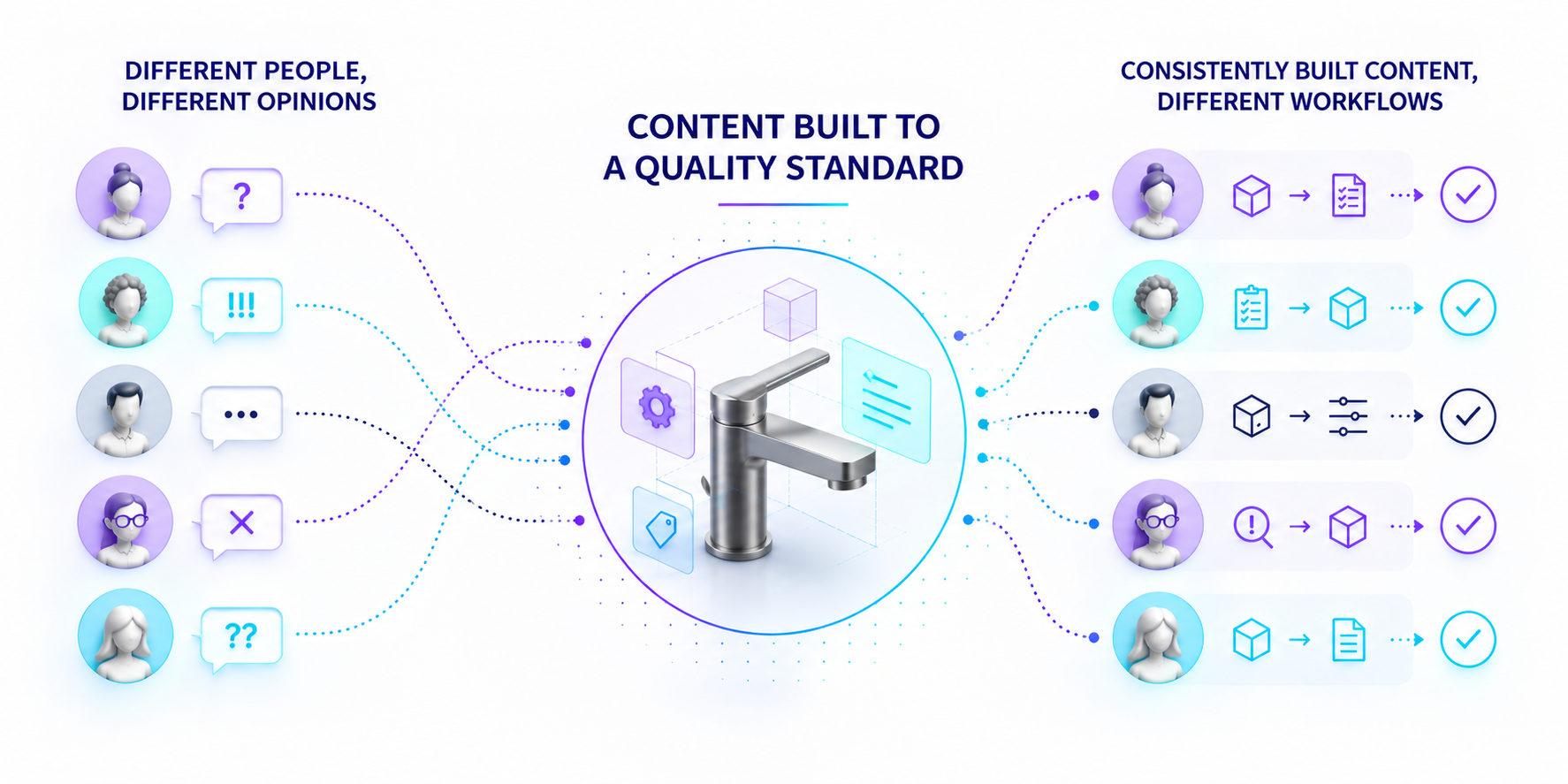
How can manufacturers know if their BIM content is actually good?
The most reliable assessment combines several forms of evidence rather than relying on a single signal.
Direct feedback from architects and designers remains valuable. Usage and engagement data can show whether people are finding and accessing the library. Feedback from BIM Managers and other design-technology specialists can provide a different perspective on technical quality and suitability for wider adoption.
An independent technical review can then examine the content itself: how it has been constructed, whether it follows appropriate Revit practices, how consistently the library behaves and whether there are issues that may not be obvious during a visual inspection.
Together, these provide a much more useful picture than relying on comments such as ‘the files look good’ or assuming that the absence of complaints means there are no problems.
What should manufacturers do with an existing BIM library?
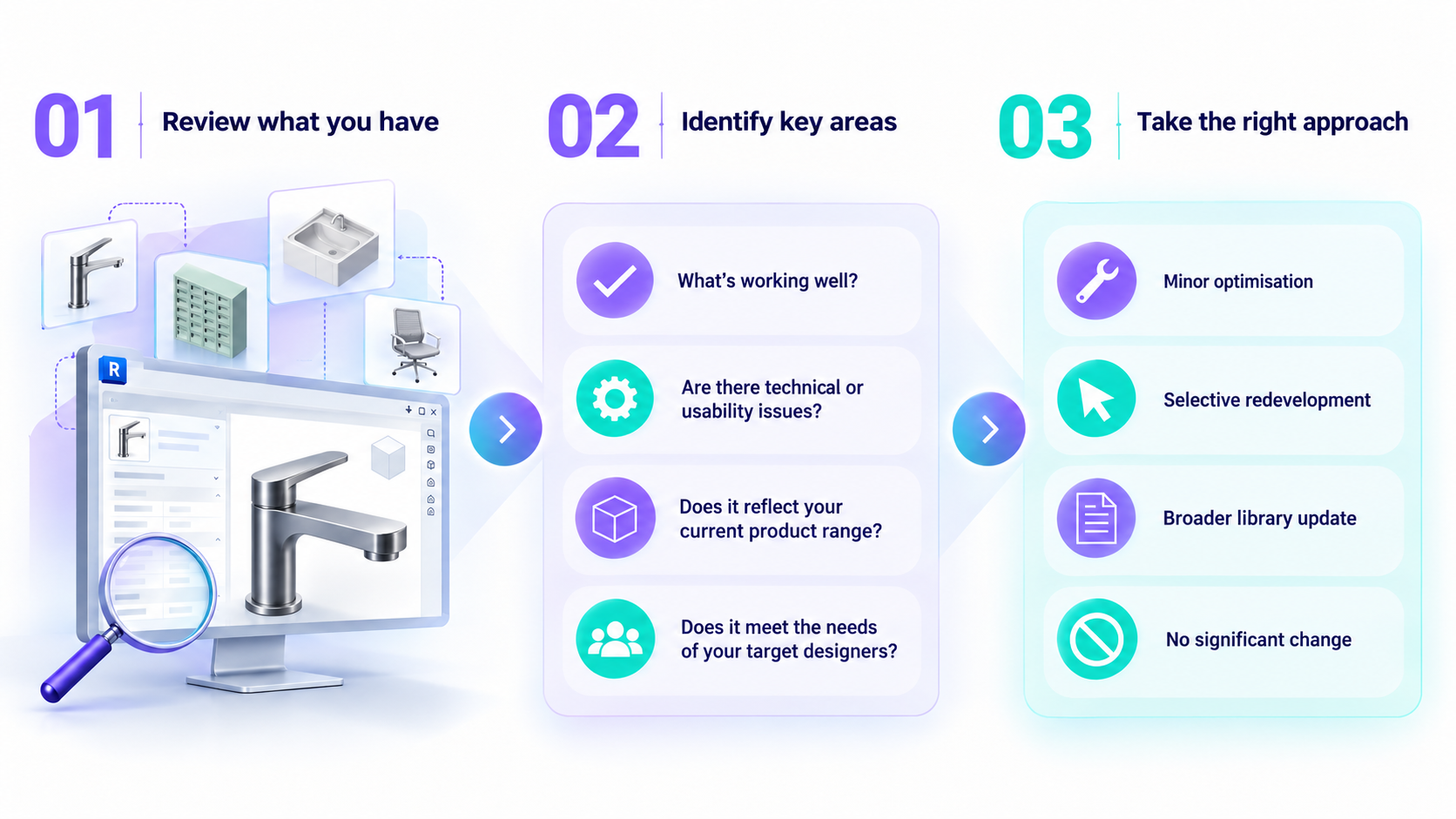
Having existing BIM content does not automatically mean it needs to be rebuilt. The first step should be to understand what you already have.
A structured review can identify which parts of the library are working well, where technical or usability issues exist, whether the content still reflects the current product range, and whether it meets the expectations of the designers and practices the manufacturer wants to reach.
From there, the appropriate response might be minor optimisation, selective redevelopment, a broader library update or, in some cases, no significant change at all.
This approach helps manufacturers invest where improvement is genuinely required rather than assuming that positive feedback proves everything is fine – or, at the other extreme, assuming that an older library needs to be replaced in full.
Closing the BIM Feedback Gap
The BIM Feedback Gap exists because manufacturers and design practices experience BIM content from different sides of the workflow.
Manufacturers see the files they have commissioned, the downloads they receive and the feedback that makes its way back to them. Designers and BIM teams see what happens when those files are introduced into real project environments.
Bringing those perspectives together gives manufacturers a much clearer understanding of whether their BIM investment is doing what it was intended to do: making their products easier to design with, document and specify.
Not sure how your BIM content would be assessed by a design practice?
IGS works with building product manufacturers and design practices to develop, review and manage manufacturer BIM content. Our team can assess an existing library from the perspective of the people who need to use and manage it in real project environments.
Our Free BIM Content Adoption Review provides an initial assessment of your existing content and can help identify issues or opportunities that may not be visible through customer feedback alone.
Learn more about IGS BIM Content Creation
... Return to the Knowledge Hub ...
Table of Contents
Sign up today for news, industry insights & content releases!
You can unsubscribe at any time by clicking the link in the footer of our emails. For information about our privacy practices, please visit our privacy policy.
FAQs
Related Posts



The building industry is rapidly evolving. Don’t get left behind!
Join the growing list of leading brands who leverage our BIM Content Creation Services
and associated Building Product Marketing Strategies to grow your business.
Contact Us
We look forward to speaking with you!
For inquiries about BIM content creation, web or product marketing solutions as well as general inquiries and support, please fill out the contact form provided, or contact us via the details below.
1300 980 763