

Is a Phased Approach to BIM Content Library Development a Superior Strategy?
Instead of creating BIM content for your entire product offering in one go, breaking it into pre-planned phases offers some unique advantages. Let’s explore why a phased approach can sometimes be the best strategy for manufacturers looking to develop a BIM content strategy.
Why a Phased Approach to BIM Library Development is the Superior Strategy
When manufacturers decide to invest in a BIM content library, the natural instinct is sometimes to think big – to develop everything at once, get it all done, and have a comprehensive offering ready to launch into the market. But while this might seem like the fastest way to “get BIM done”, in certain circumstances it can be a less effective strategy compared to a phased approach.
Instead of trying to create a BIM library for all your products in one go, breaking it into well-planned phases can offer unique advantages. Let’s explore why a phased approach is sometimes the superior strategy for manufacturers looking to maximise their ROI from a BIM content strategy.
1. Better Cash Flow Management
Depending on the kind of products you supply and the size of your product offering, developing a comprehensive library of high quality BIM content for a whole building product portfolio can be a significant financial investment. A phased approach allows you to spread this cost over time, making it easier to manage cash flow while making steady progress towards the end goal of being able to offer a complete BIM content library to the specifier community.
Rather than taking a big financial hit all at once, you can allocate budget progressively, aligning each phase with strategic goals, New Product Development (NPD) cycles, or other business priorities. This approach not only reduces financial strain, it also allows for adjustments based on performance, feedback and changing priorities.
2. Streamlined Resource Allocation
Creating BIM content can require a fair bit of input from the manufacturer, from product drawings and performance data, to detailed technical specifications and product configuration guidance. However, not all manufacturers have all this information readily available for every product.
By taking a phased approach, you can start with the products that have the most complete data available, whilst working on gathering or refining the details for other products in your BIM content creation pipeline. This prevents bottlenecks and allows the project to move forward without delays.
Additionally, an all-at-once approach can overwhelm internal teams who need to provide approvals, technical input, or marketing coordination. Breaking it into phases can make the process far more manageable.
3. Faster Time-to-Market
Instead of waiting until BIM content has been created for every single product, a phased approach enables manufacturers to launch and start benefiting from a BIM content strategy much sooner.
By prioritising key products – those that are most commonly specified, or that align with current design trends and upcoming projects – you can establish a presence for your BIM content in the market more quickly. This means designers can start using your BIM content in their projects faster, and you can evolve your relationships with specifiers by being known as a supplier committed to providing high quality BIM content for your products much earlier.
A phased rollout also allows you to identify any tweaks or improvements needed before the next phase of your BIM content library plan, ensuring BIM content developed in future stages aligns with your customers’ needs even better.
Read our partnership Success Story here with Aspect Furniture, which incorporated a process for regular, phased BIM content library creation by IGS Group:

4. Enhanced Marketing Opportunities to Specifiers
One of the biggest marketing advantages of a phased approach is it gives you multiple opportunities to engage with specifiers. Instead of a single big launch, which risks getting lost in the noise, each phase provides a new reason to communicate and reconnect with your audience.
Every phase, whether it’s adding new product ranges, enhancing existing models, or launching new features, becomes a fresh opportunity to:
- Announce updates to your email list
- Create new social media content (especially for LinkedIn)
- News to share with industry media outlets
- Run targeted advertising campaigns for specific product categories or design disciplines
- Re-engage architects and designers who may not have specified your products yet
- Maintain visibility throughout the year instead of a single launch that might fade quickly
This continuous engagement builds stronger relationships with specifiers and keeps your brand top of mind. A one-and-done approach – whilst offering some unique benefits of its own – doesn’t allow for tthe same sustained visibility.
5. Flexibility to Adjust Based on Market Demand
Building a BIM library is not just a technical exercise, it’s a strategic business initiative. A phased approach gives you the flexibility to adapt based on ‘real-world’ insights from your customers, your team, or the industry at large.
For example, after launching the first phase, you might find that certain product categories are in higher demand than expected. This insight allows you to prioritise the next phase accordingly, rather than investing resources into less relevant content.
This also applies to evolving BIM standards and technology. By taking an iterative approach, you can incorporate these insights into later phases.
6. Sustainable, Long-Term Quality
A phased rollout naturally builds a culture of continuous improvement into your BIM content strategy. Rather than treating BIM content as a one-time project that gets “finished” and forgotten, you create a system where content is regularly reviewed, updated, and enhanced.
This approach ensures your library remains high-quality, accurate, and aligned with the latest industry trends – ultimately making your products and your BIM content library more useful to designers over the long term. And no product portfolio stays the same forever, so updates are inevitable, even if it’s just to add, subtract or modify BIM content to align with a changing product offering.
Implementation Best Practices
Based on our experience with successful building product manufacturers, consider these guidelines when planning your phased BIM strategy:
- Start with high-impact products – Focus initial phases on products with the highest specification potential or those frequently requested by designers
- Product data is key – Make your first phase of BIM content creation as smooth as possible by starting with products you have a good amount of data for (i.e. 3D CAD models, spec sheets, material swatches)
- Develop a clear roadmap – With our support, create a structured timeline for subsequent phases based on strategic priorities
- Communicate your plan – Let specifiers know what’s available now and what’s coming next to build anticipation
- Gather feedback between phases – Use insights from early adopters to refine future content
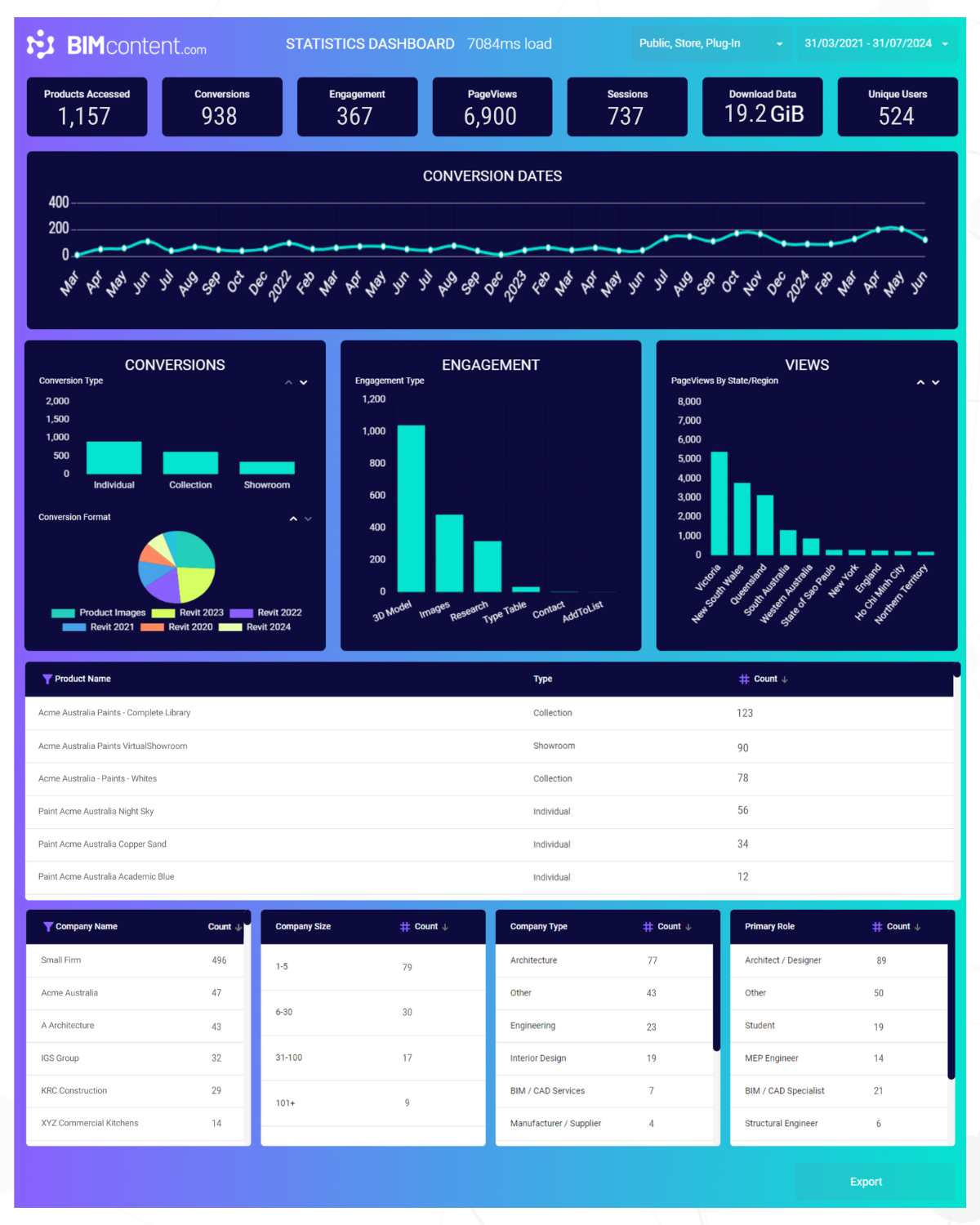
- Leverage analytics – Track BIM content download stats and user engagement via your BIMcontent.com admin portal to help inform your strategy
Final Thoughts
Whilst the idea of developing a full BIM content library all at once often seems appealing, the reality is a phased approach offers unique benefits. It helps manage cash flow, speeds up time-to-market, provides for multiple marketing opportunities, and allows for flexibility based on market insights.
Importantly, it acknowledges your BIM content strategy is an ongoing ‘Business As Usual’ (BAU) initiative, rather than a one-time project. And in an industry where staying relevant and top-of-mind with specifiers is key, that’s a huge benefit.
So, if you’re considering creating a BIM content library for your products, don’t fall into the trap of thinking it has to be done all at once. Instead, think about taking a strategic, phased approach, as this may be the best approach for your business.
... Return to the Knowledge Hub ...
Table of Contents
Sign up today for news, industry insights & content releases!
You can unsubscribe at any time by clicking the link in the footer of our emails. For information about our privacy practices, please visit our privacy policy.
FAQs
Related Posts



The building industry is rapidly evolving. Don’t get left behind!
Join the growing list of leading brands who leverage our BIM Content Creation Services
and associated Building Product Marketing Strategies to grow your business.
Contact Us
We look forward to speaking with you!
For inquiries about BIM content creation, web or product marketing solutions as well as general inquiries and support, please fill out the contact form provided, or contact us via the details below.
1300 980 763