



Beyond ‘Hollywood BIM’ – Why 2D Construction Details Are Valuable BIM Content
While the industry gets excited about impressive 3D renders and VR walkthroughs - what some call "Hollywood BIM" - the reality is that 2D construction details still do much of the heavy lifting in real project delivery. Yet most manufacturers overlook this critical component when developing their BIM strategy. For products like waterproofing membranes, flashings, and structural interfaces, well-crafted 2D details showing exactly how products integrate with surrounding elements can be more valuable to specifiers than any 3D family. This is where specification becomes reality, and where manufacturers can provide genuine value by taking documentation work off designers' plates.

When talking about BIM, it’s easy to get caught up in the glamour of realistic renders, VR environments and highly detailed project fly-throughs… a part of the industry sometimes referred to (tongue-firmly-in-cheek) as ‘Hollywood BIM’.
3D visuals and renders look great. They impress clients, and they’re often the hero of stakeholder engagement processes and marketing campaigns. And 3D project models are invaluable for things like coordination, clash detection and design communication. But when it comes to real-world project delivery, 2D construction drawings and documentation still do a lot of the heavy lifting in defining whether projects are delivered smoothly or not.
And yet, when thinking about what specifiers might want from building product manufacturers in this new ‘BIM-enabled’ era, many manufacturers (and most BIM content providers) overlook 2D content as a critical component of a BIM content strategy.
Designers Aren’t Just Modelling – They’re Documenting
At IGS Group, we speak to architects, engineers and construction documentation specialists every day, and they consistently tell us that producing all the smart, natively modelled Revit details they need for their projects is both time-consuming and difficult. In many firms, teams simply don’t have the time to create 2D details for complex junctions, installation methods, or intricate detailing from scratch, and they’d be grateful if there was more ready-made manufacturer-specific 2D construction details available.
When manufacturers provide pre-drawn construction details in Revit, they’re not just offering a convenience; they’re taking a massive chunk of work off a designer’s plate. It’s a value-add that has a significant and measurable impact on project efficiency and documentation quality.
For Some Products, 2D Is the Main Event
Not all building products need a fully parametric, geometry-rich 3D family. For certain types of elements – like wall waterproofing membranes, sealants, structural interfaces, flashings, structural separation joints, roof penetrations, fire-stopping systems, façade subframes, and other ‘junction-centric’ components, the most helpful content isn’t always a 3D Revit family. It might actually be a set of clear, well-structured 2D construction details that show exactly how the product integrates with its surrounding elements.
In these cases, the 2D detail is the BIM content.
Why 3D Models Aren’t Enough
Contrary to what manufacturers sometimes expect – usually the result of having seen a lot of ‘Hollywood BIM’ in their travels – 3D Revit families aren’t high-fidelity replicas of real-world products. They’re intentionally simplified in their 3D representation to keep project models lightweight and easy to work with. Overly detailed Revit families slow down model performance and create unnecessary complexity, and designers generally avoid using them.
That’s why critical installation and integration information – things like membranes, flashings, setdowns or fixings – are almost always better communicated through 2D construction details.
An Integrated Content Ecosystem
For many manufacturers, the ideal BIM content library includes a mix of 3D families, 2D details, and associated materials or texture assets. Each serves a different purpose within the project lifecycle and is used to develop particular project deliverables.
- 3D families: help with spatial coordination, visualisation, and design communication.
- 2D details: support documentation, installation, and compliance.
- Material assets: support accurate rendering, optioneering and visibility compliance.
When accessible and used together, these assets form a complete toolkit for designers and specifiers. At IGS, we view these not as isolated deliverables, but as a holistic project delivery library, where each asset plays a specific role in helping a product make its way from design to documentation to procurement to installation.
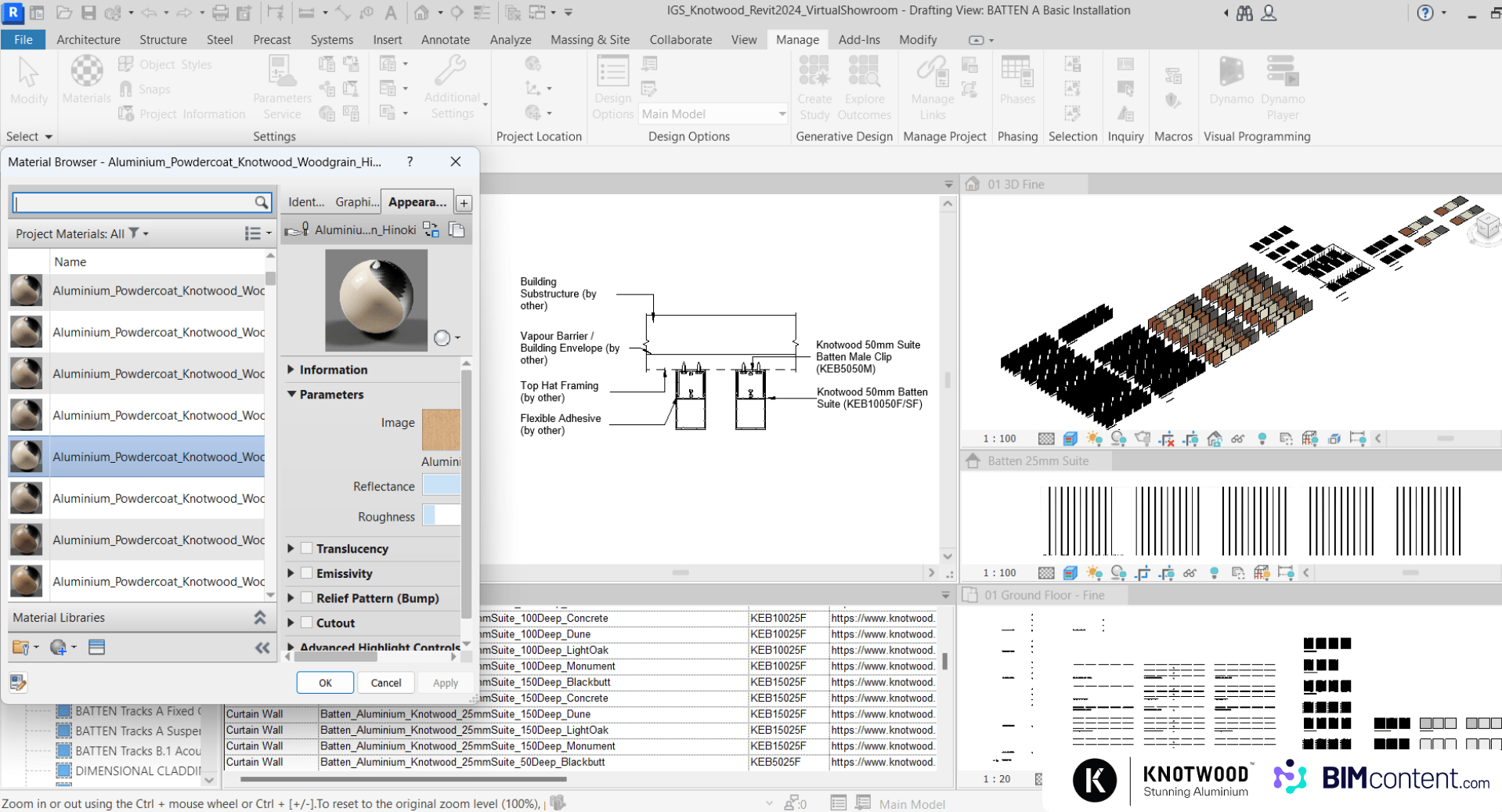
Detail Is Where the Brand Becomes Real
There’s something often overlooked when talking about 2D details: they are typically more specific to a particular manufacturer than a 3D family of Material / Texture would be.
Think about a commercial cladding system – a 3D model with a texture applied might show you the panel layout and help with accurate visualisation and coordination, but it rarely tells the full story. What about the cavity structure, the framing system, the sarking, the flashings, the junction with window heads, sills, and parapets?
That’s where 2D construction details become invaluable. These details capture the real-world complexity and integration requirements of the system. They reflect how that specific manufacturer’s solution is meant to be installed, and how it interfaces with adjacent building elements.
This is where the specificity of a manufacturer’s product truly comes to life. It’s where design meets compliance. It’s where specification becomes reality.
When a designer inserts your 2D detail into a project drawing set, that’s not a ‘symbolic visual’ of your products. That’s a reliance and commitment to your product. And that’s what’s most likely to see your specifications result in actual sales.
At BIMcontent.com, 2D Content Has Always Been a First-Class Citizen
From day one, we’ve believed in the equal value of 2D and 3D BIM assets. And through our BIMcontent.com platform, we’re proud to host and promote a growing library of high-quality 2D content from leading manufacturers the industry depends on. We know 2D assets aren’t just a ‘nice-to-have’. Specifiers are proactively searching for it, using it, and relying on it to deliver their projects accurately.
We’re committed to expanding the range of construction details on the platform, and helping manufacturers understand the importance of this often underappreciated BIM content type.
So yes. 3D BIM content is great. No question. But in a world that still runs on documentation, don’t forget the details!
... Return to the Knowledge Hub ...
Table of Contents
Sign up today for news, industry insights & content releases!
You can unsubscribe at any time by clicking the link in the footer of our emails. For information about our privacy practices, please visit our privacy policy.
FAQs
Related Posts


The building industry is rapidly evolving. Don’t get left behind!
Join the growing list of leading brands who leverage our BIM Content Creation Services
and associated Building Product Marketing Strategies to grow your business.
Contact Us
We look forward to speaking with you!
For inquiries about BIM content creation, web or product marketing solutions as well as general inquiries and support, please fill out the contact form provided, or contact us via the details below.
1300 980 763